
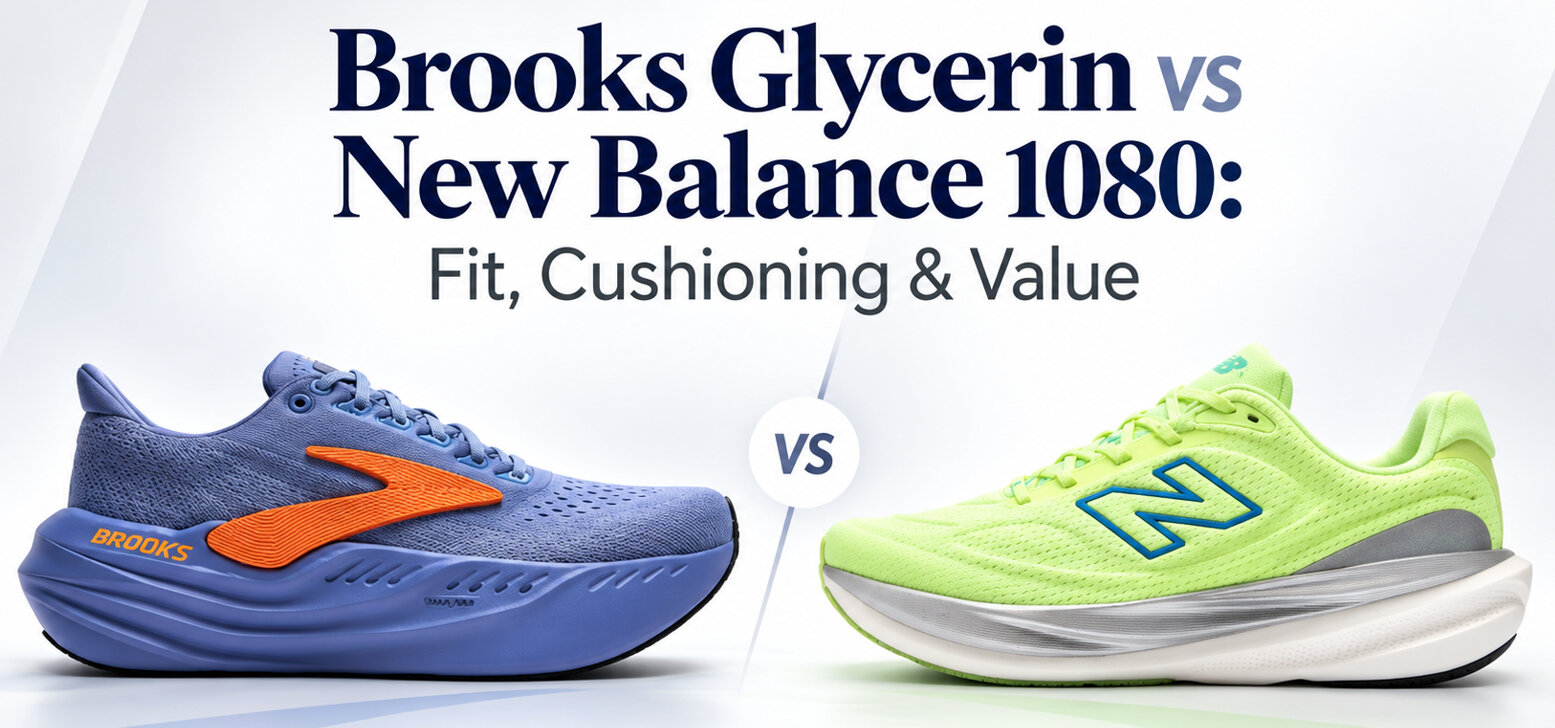
The Brooks Glycerin vs New Balance 1080 matchup compares two premium comfort shoes with very different personalities. Glycerin 23 feels plush, stable, and substantial. New Balance 1080v15 is lighter, lower-drop, and more energetic.
Let’s compare cushioning, fit, daily running, long runs, and walking.
Brooks Glycerin vs New Balance 1080: The Biggest Difference Is Ride Feel
Both are premium daily trainers, max cushion running shoes, and neutral running shoes built for road mileage. Yet Glycerin 23 delivers controlled plushness through a broad platform, while 1080v15 combines resilient cushioning with noticeably lower weight.
Brooks Glycerin vs New Balance 1080 for Cushioning and Comfort
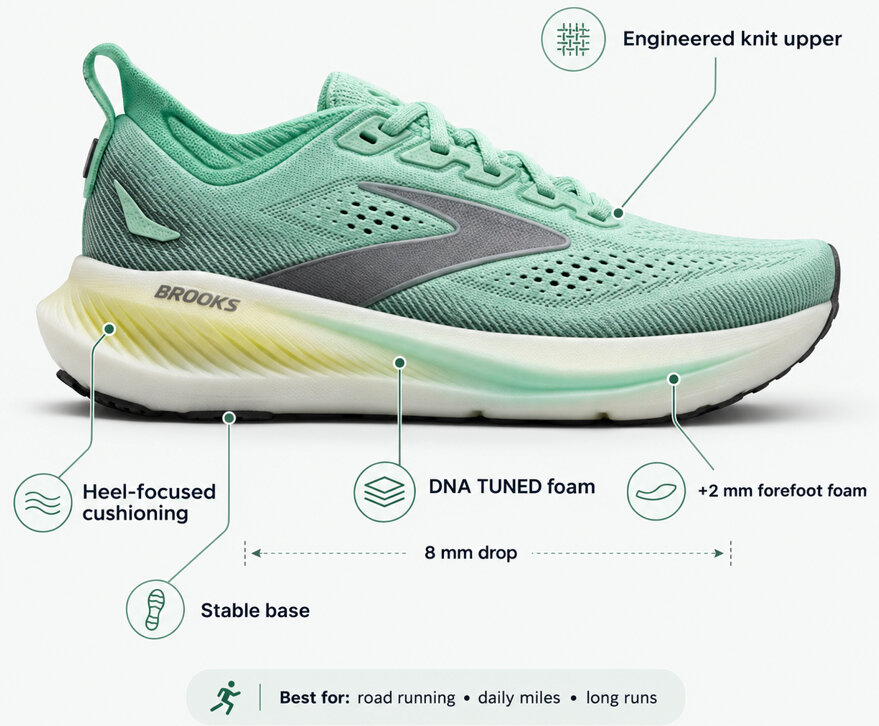
The Brooks Glycerin 23 uses nitrogen-infused, dual-cell DNA TUNED foam. Larger heel-focused cushioning softens heel strikes, while the foam configuration supports forefoot toe-off. Brooks also added another 2 mm of forefoot foam, increasing cushioning without turning the shoe into an unstable pillow.
A wide platform improves stability and supports stable transitions, while the engineered knit upper creates an accommodating fit and allows natural foot movement. The result is plush cushioning with a more structured feel than many ultra-soft cushioned running shoes.
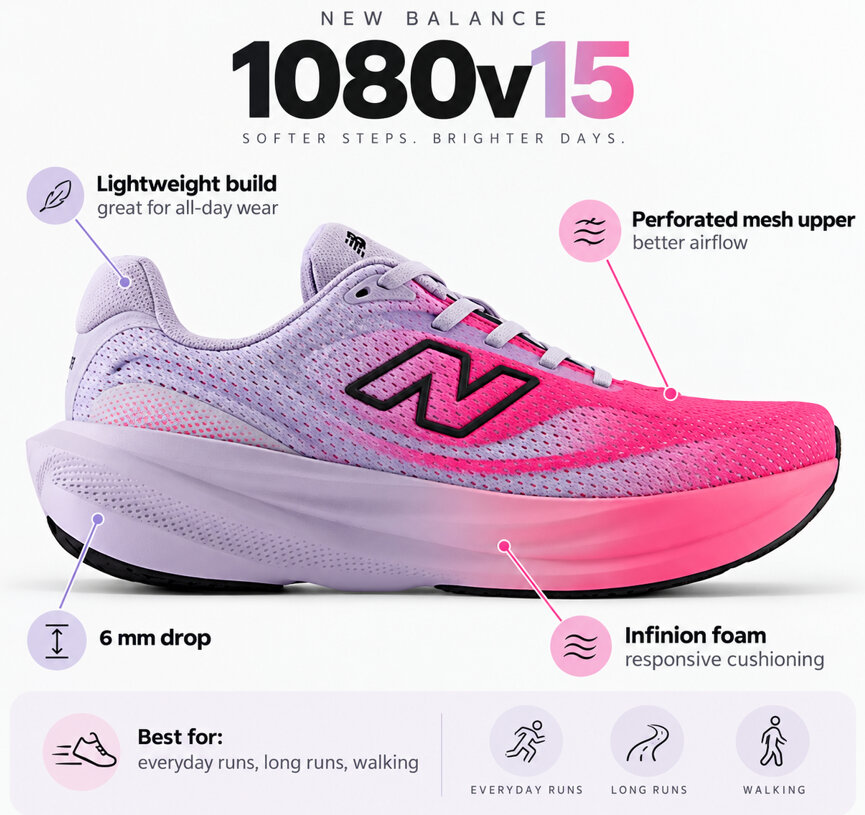
The New Balance 1080v15 takes a different route. Its new Infinion foam replaces Fresh Foam X and provides resilient cushioning with improved energy return. New Balance pairs it with a lightweight perforated mesh upper for better airflow.
Brooks Glycerin vs New Balance 1080 for Daily and Long Runs
Both shoes target everyday running and work as long run shoes. Glycerin 23 is officially designed for road running, everyday miles, and long runs, and its stable base supports relaxed mileage when pace is not the priority.
The 1080v15 also targets everyday and long-distance running. Its lighter construction benefits longer runs, while Infinion foam makes the current version more responsive than the older 1080 models that relied on Fresh Foam X.
If you prefer a calm, planted ride for easy runs, Glycerin has the edge. If your intended pace sometimes changes during a run, the lighter 1080 feels easier to move.
Weight and Heel Drop Change How They Run
The difference in weight is substantial. Men’s Glycerin 23 weighs 300.5 g, and the women’s version weighs 269.3 g. By comparison, men’s 1080v15 weighs 261 g, while the women’s version is roughly 205.9 g.
That lower weight improves running agility and makes the 1080 feel less cumbersome during longer sessions. Glycerin compensates with a broad platform that improves stability and creates a reassuringly substantial feeling underfoot.
Drop also separates them. Glycerin 23 has an 8 mm drop, while 1080v15 uses a 6 mm drop. The higher drop shifts the Glycerin’s geometry toward a more traditional heel-to-toe setup, while 6 mm creates a lower-drop geometry in the 1080.
Neither number is automatically better. Your preferred ride feel, ankle mobility, gait, and previous footwear should determine which geometry feels natural.
Fit, Toe Box, and Width Options
Brooks uses a soft engineered knit upper designed around an accommodating fit. Men’s Glycerin 23 comes in Medium D, Wide 2E, and Extra Wide 4E, making it a strong wide running shoes option.
New Balance goes even further. Men’s 1080v15 comes in Narrow B, Standard D, Wide 2E, and Extra Wide 4E. Women’s options range from Narrow 2A through Extra Wide 2E, giving the 1080 one of the broader width ranges in this category.
Wide sizing accommodates broader feet, but width labels are not the whole story. Foot shape affects fit preference, and correct fit improves running comfort, especially through the toe box and heel.
Stability, Walking Comfort, and All-Day Wear
The standard Glycerin 23 uses balanced support, not traditional motion control. Its secure heel, dynamic forefoot, tuned cushioning, and wide base create inherent stability. Runners needing additional guidance can move to Glycerin GTS 23, which adds GuideRails support.
The 1080v15 is officially a neutral support shoe. Current testing found its platform more stable than the previous version, although its lower weight and softer geometry give it a different sensation from Glycerin’s broad, planted base.
Both also work well as walking shoes. Soft cushioning reduces road impact, but the 1080’s lighter construction makes it particularly appealing for walking comfort and all-day wear. Glycerin is attractive if you prefer more underfoot protection and a sturdier feel.
Outsole, Durability, and Value
The 1080v15 uses a rubber outsole, which protects the midsole and provides road contact where needed. Independent 300 km testing found that its Infinion foam maintained its character impressively well, suggesting a meaningful durability improvement over earlier generations.
Glycerin 23 is also built as a high-mileage daily trainer. Its stable platform and DNA TUNED cushioning favor consistent mileage rather than speed-focused workouts.
Price is nearly identical. Glycerin 23 currently costs around $175, while 1080v15 is nearly at $170 in the U.S. That small difference should matter less than fit and ride preference.
Pros and Cons
Brooks Glycerin 23
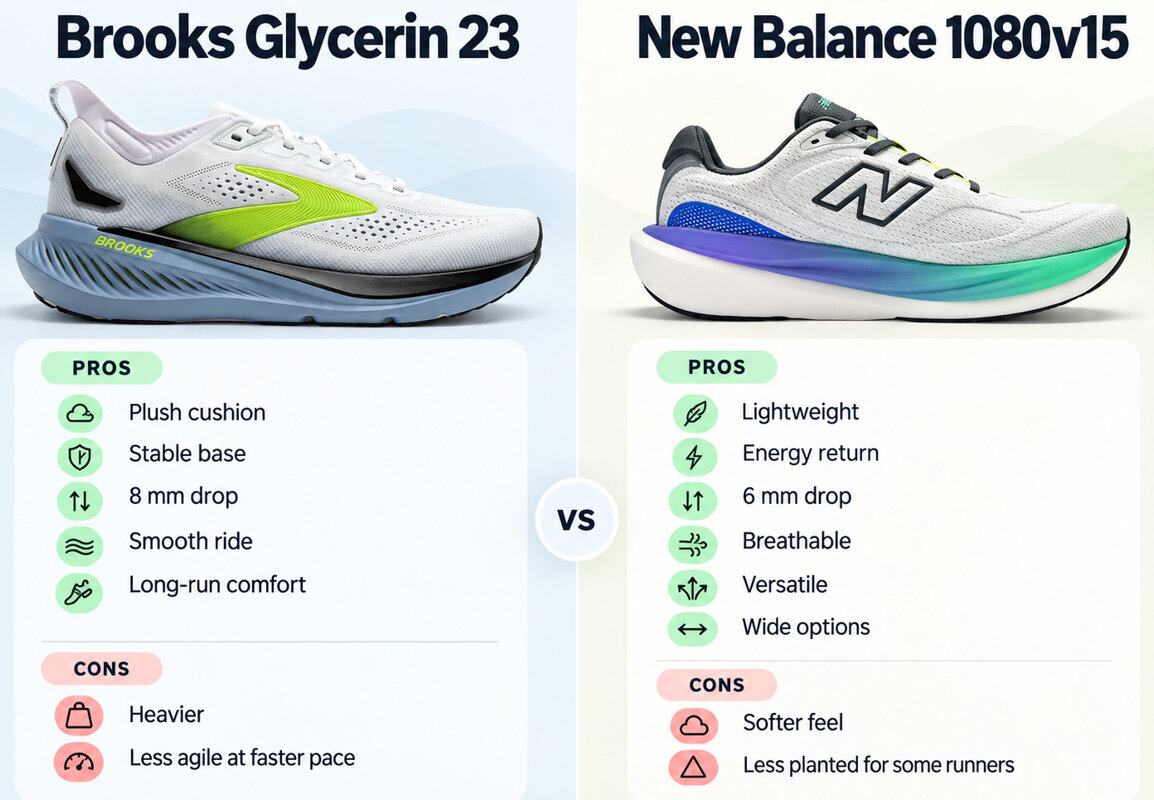
- Pros: plush DNA TUNED cushioning, stable broad base, 8 mm drop, comfortable knit upper, strong heel cushioning, smooth transitions, and excellent long-run comfort.
- Cons: substantially heavier than 1080v15 and less agile when you want to increase pace.
New Balance 1080v15
- Pros: lightweight design, Infinion energy return, 6 mm drop, breathable mesh, excellent width selection, soft cushioning, and strong versatility for running and walking.
- Cons: the lower-drop, softer ride may feel less traditionally planted than Glycerin to some runners.
FAQ
1. Which is softer, Brooks Glycerin or New Balance 1080?
Both feel soft, but they achieve comfort differently. The 1080v15 emphasizes resilient softness through Infinion foam, while Glycerin 23 feels plush but more controlled and stable through DNA TUNED cushioning and its broad platform.
2. Which is better for long runs?
Both are designed for long runs. Choose Glycerin 23 if stability and controlled cushioning matter most. Choose 1080v15 if you prefer lower weight and more noticeable energy return over long distances.
3. Which is better for wide feet?
Both offer wide and extra-wide sizes. However, 1080v15 has the wider overall size range because men’s models also include Narrow B alongside D, 2E, and 4E.
4. Is Brooks Glycerin more stable than New Balance 1080?
Glycerin 23 generally feels more planted because of its wide platform and balanced support geometry. The current 1080v15 is also significantly more stable than its predecessor, so neither should automatically be considered unstable.
5. Which is better for walking?
For pure walking and all-day wear, the lighter New Balance 1080v15 gets a slight advantage. If you prefer a firmer sense of structure and a higher 8 mm drop, Glycerin 23 may feel better.
Closing Words
In Brooks Glycerin vs New Balance 1080, choose Glycerin 23 for stable, controlled plushness and 1080v15 for lighter, livelier comfort. Both are excellent daily trainers, so let your preferred drop, foot shape, and ride feel make the final choice.