
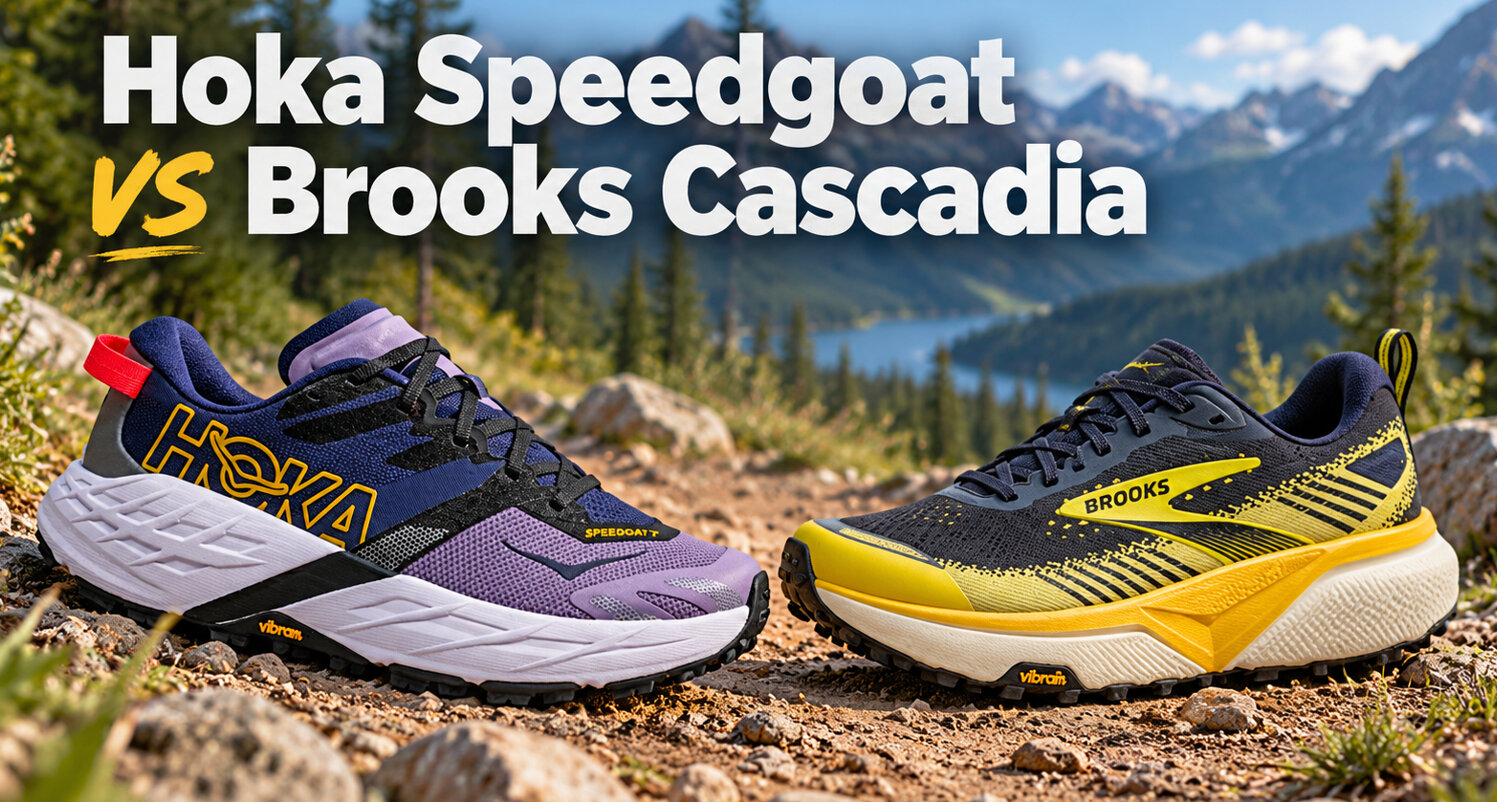
The Hoka Speedgoat vs Brooks Cascadia matchup has changed dramatically in 2026. Speedgoat 7 is lighter, more responsive, and aggressively grippy. Cascadia 20 is heavier but more stable and versatile. Both are serious trail running shoes built for long days off-road.
Hoka Speedgoat vs Brooks Cascadia: Technical Grip or Stable Versatility?
The main choice is straightforward. Hoka Speedgoat 7 favors technical terrain, secure downhill running, and long-distance efficiency. Brooks Cascadia 20 favors stable trail running, hiking, and predictable performance across changing surfaces.
Hoka Speedgoat vs Brooks Cascadia for Technical Terrain
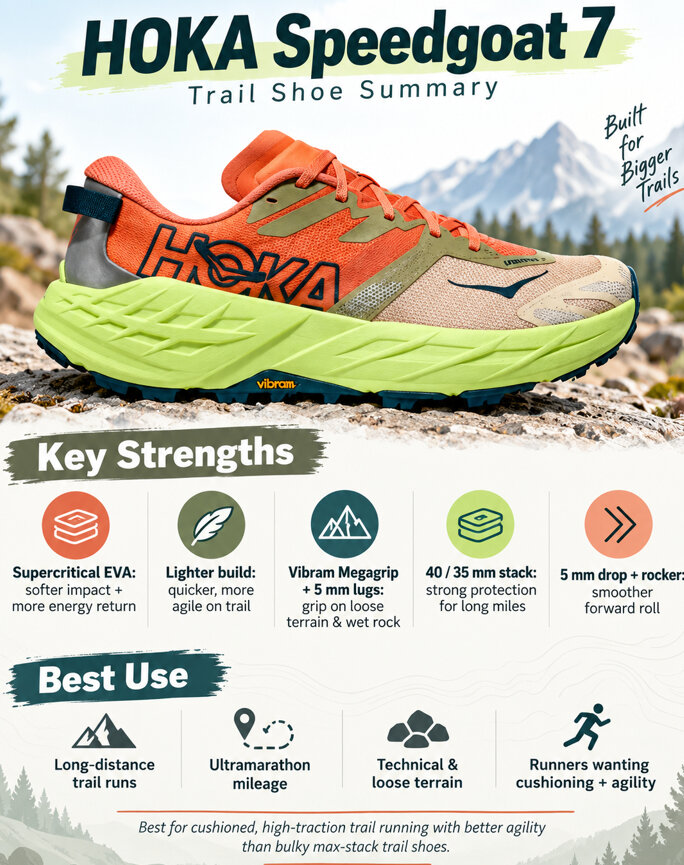
Speedgoat 7 uses supercritical EVA that absorbs trail impact while returning more energy than the previous foam. At only 275 g for men and 235 g for women, its lighter weight improves trail agility when climbing, descending, or changing direction.
Underneath, Vibram Megagrip works with 5 mm lugs and a redesigned lug orientation. Those deeper lugs bite into loose terrain, while Megagrip rubber provides confidence on wet rock. A secure RPET woven upper improves downhill lockdown.
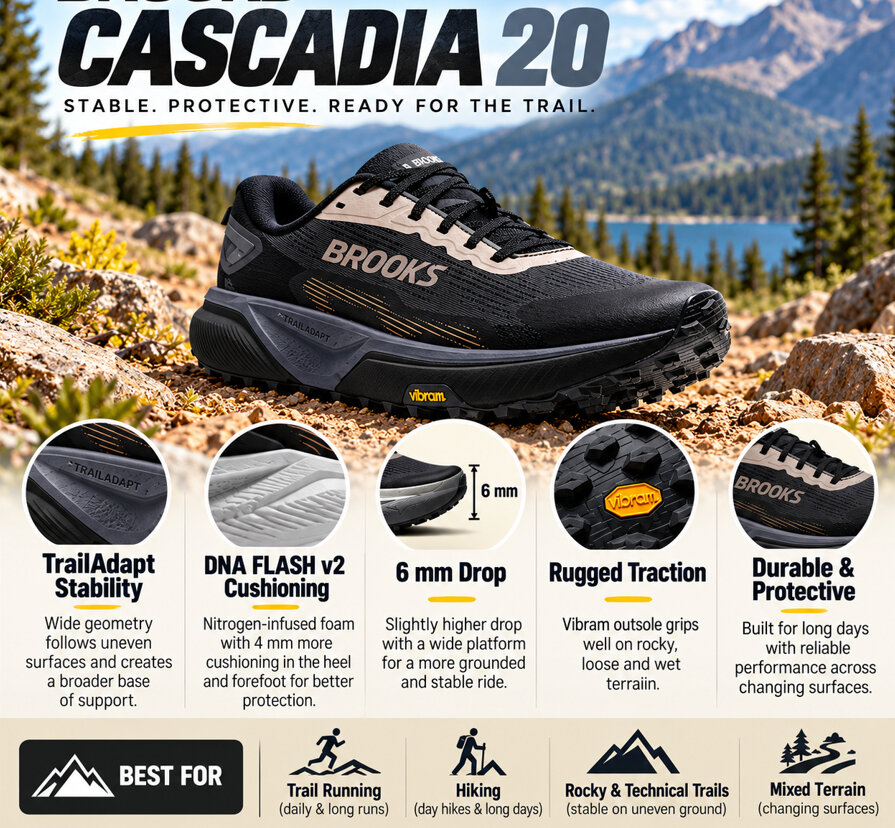
Cascadia 20 is also a genuine pair of technical trail shoes, but its personality is calmer. Its wide TrailAdapt geometry follows uneven surfaces and creates a broader base of support, so it feels planted on rocky trails and irregular ground.
Hoka Speedgoat vs Brooks Cascadia for Long Trail Runs
Speedgoat has long been associated with ultra trail running shoes, and version 7 continues that role. Independent testing places its stack around 40 mm at the heel and 35 mm at the forefoot, giving your feet substantial protection during long-distance trail running and ultramarathon mileage.
Cascadia 20 also works for long days. Brooks added another 4 mm of nitrogen-infused DNA FLASH v2 cushioning through the heel and forefoot, making the current model more protective than its predecessor.
If you want a lighter, more energetic long-run shoe, Speedgoat wins. If you prefer stability as fatigue builds, Cascadia is compelling.
Cushioning and Ride Feel Are Now More Responsive
The biggest Speedgoat update is its super-critically foamed EVA. Responsive foam returns energy while tall cushioning protects the feet over long distances. Hoka officially classifies the ride as responsive rather than simply plush.
Speedgoat 7 also uses a 5 mm drop, creating relatively low-drop trail geometry. Its rocker-assisted shape encourages forward motion, which helps the shoe feel more fluid despite its high stack.
Cascadia 20 uses DNA FLASH v2. The nitrogen-infused foam cushions rough landings, but the shoe feels more controlled than Speedgoat. Its 6 mm drop is only slightly higher, yet the wide platform creates a more grounded experience.
Traction: 5 mm vs 4 mm Vibram Lugs
This comparison used to strongly favor Hoka. Not anymore.
Both are now Vibram trail shoes using Vibram Megagrip and Traction Lug technology. Speedgoat uses deeper 5 mm lugs, while Cascadia uses 4 mm lugs.
The deeper Speedgoat tread gets our preference for loose, steep, and more aggressive terrain. Cascadia’s 4 mm lugs provide more versatile traction across firm dirt, gravel, wet terrain, and mixed hiking surfaces.
Neither is a dedicated deep-mud specialist. For ordinary mountain and mixed-surface trail running, however, outsole grip is excellent on both.
Stability, Protection, and Rocky Trails
Cascadia’s strongest argument is stability. TrailAdapt Technology combines a wide platform with flexibility in selected areas, helping the shoe adapt to uneven terrain without feeling excessively loose.
The current Cascadia does not rely on the traditional rock plate found in some older generations. Instead, higher cushioning, the broad platform, a protective toe cap, and mudguard shield the foot. The toe cap protects the forefoot, while the mudguard helps protect the upper.
Speedgoat also has no conventional rock plate. Its tall cushioning provides much of the protection, while its secure upper and traction make technical descents its specialty.
So, for maximum predictable stability on rocky trails, we lean Cascadia. For faster movement and confident technical descending, we prefer Speedgoat.
Fit, Width, and Foot Lockdown
Fit can decide this comparison before terrain does. Speedgoat’s secure upper improves trail confidence, but the standard version can feel snug for wide or high-volume feet. A dedicated Speedgoat 7 Wide is available.
Cascadia 20 comes in men’s Medium 1D and Wide 2E. Its soft air-mesh upper improves ventilation, while 3D overlays reinforce high-wear zones and improve trail durability.
Both therefore work as wide trail running shoes, but fit them rather than assuming the same labeled width will feel identical.
Hiking, Ultra Running, and Everyday Trail Use
Speedgoat is the stronger pick for runners who mix ordinary training with racing or ultrarunning. Its combination of lower weight, responsive cushioning, aggressive traction, gaiter integration, and secure foot lockdown gives it impressive range.
Cascadia works particularly well as trail shoes for hiking. Brooks explicitly lists hiking, varied surfaces, technical terrain, and trail running among its best uses. A stable base and protective construction make it easy to trust during slower mountain movement as well as running.
Pros and Cons
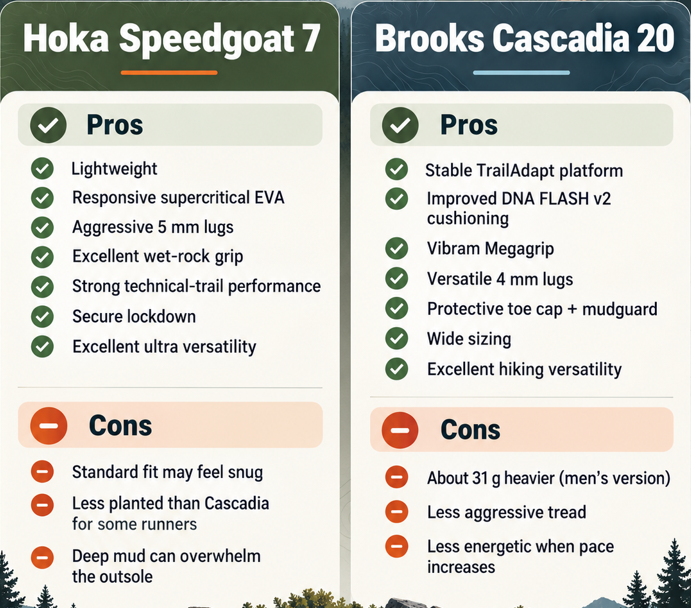
Hoka Speedgoat 7
- Pros: lightweight, responsive supercritical EVA, aggressive 5 mm lugs, excellent wet-rock grip, strong technical-trail performance, secure lockdown, and excellent ultra versatility.
- Cons: standard fit can feel snug, less planted than Cascadia for some runners, and deep mud can still overwhelm the outsole.
Brooks Cascadia 20
- Pros: stable TrailAdapt platform, improved DNA FLASH v2 cushioning, Vibram Megagrip, versatile 4 mm lugs, protective toe cap and mudguard, Wide sizing, and excellent hiking versatility.
- Cons: roughly 31 g heavier in the men’s version, less aggressive tread, and less energetic than Speedgoat when pace increases.
FAQ
1. Which has better grip, Speedgoat or Cascadia?
Both now use Vibram Megagrip, so the gap is smaller than in previous generations. Speedgoat gets the edge for aggressive terrain because its 5 mm lugs are deeper than Cascadia’s 4 mm lugs.
2. Which is better for technical trails?
Speedgoat 7 gets our preference for highly technical terrain because it is lighter, has deeper lugs, responsive cushioning, and strong downhill lockdown. Cascadia is better when you prioritize stable, predictable footing.
3. Which is better for ultramarathons?
Both can handle ultra distances. Speedgoat is preferable if you value lighter weight and responsiveness, while Cascadia suits runners who prioritize stability and protection as fatigue increases.
4. Which is better for wide feet?
Both offer Wide versions. Cascadia’s standard fit has historically been more accommodating, while Speedgoat’s regular fit remains relatively secure and snug, so wider feet should strongly consider the dedicated Wide model.
5. Which is better for hiking?
Cascadia 20 gets the slight edge for hiking because its wide platform, balanced cushioning, protective upper, and TrailAdapt geometry feel stable during slower movement across varied surfaces. Brooks also specifically lists hiking among its intended uses.
Closing words
In Hoka Speedgoat vs Brooks Cascadia, choose Speedgoat 7 for lighter weight, stronger technical grip, and ultrarunning versatility. Choose Cascadia 20 for stability, hiking, and predictable protection across varied terrain. Match the shoe to your trails, then let fit make the final call.